Thursday, September 5, 2013

Chernobyl, Part 3

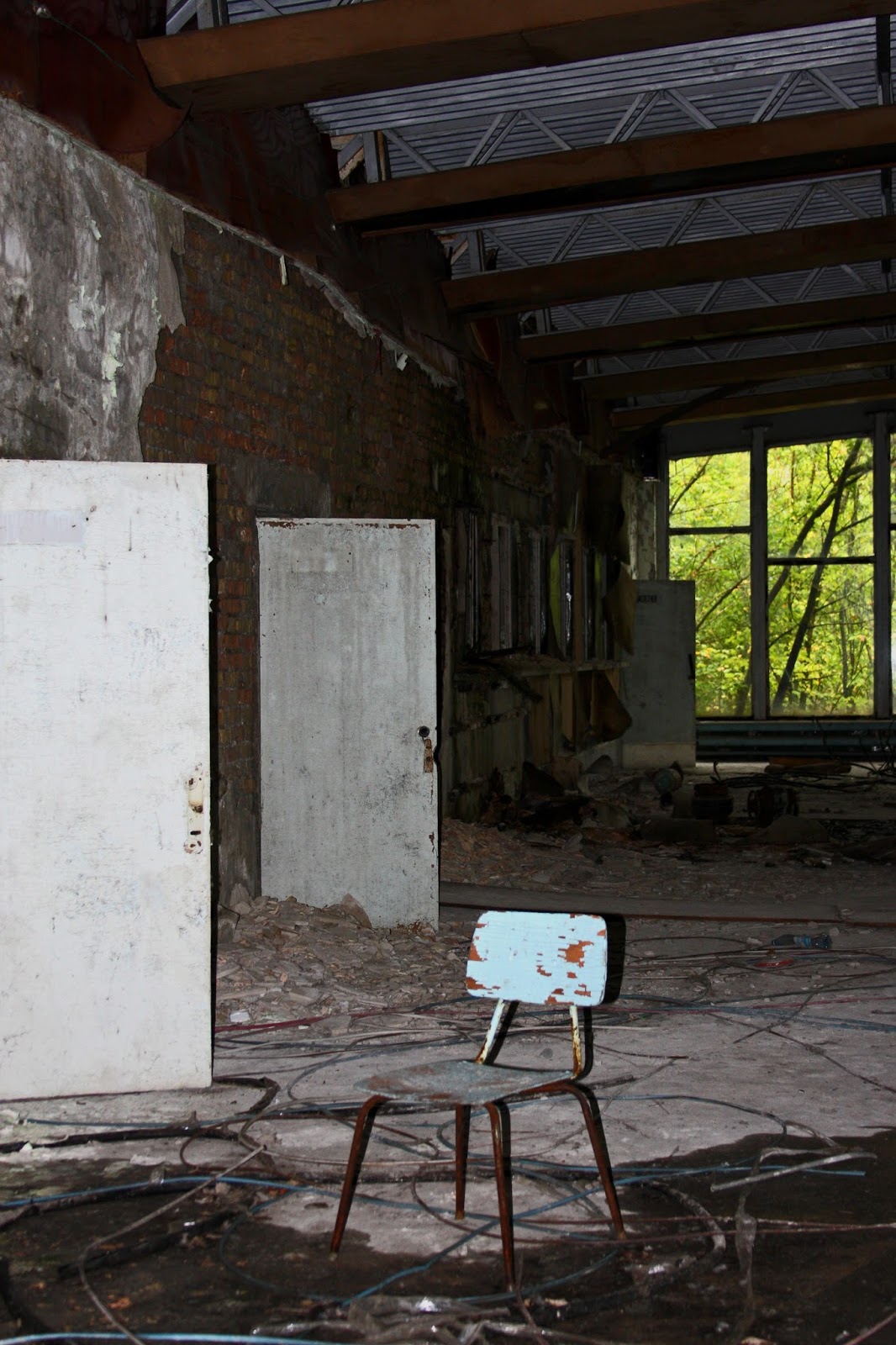
After the train yard, we had our last major stop of the day.  I'm still not really sure what this place was, I'm afraid I was thinking about the train yard still and not paying enough attention to our guide, Helen.  So, if any of my Chernobyl people are reading this, help a sister out and tell me where the hell we were.  I think it's some kind of administration building.**
This was a map of the surrounding areas.


Part of the tragedy of this place is how pretty everything is.
We drove through a portion of the Red Forest.  It was so named after the event, when the fallout killed all of the trees, turning them a rust color.  Flying over them, the forest looked red.  They pulled them down and (I'm assuming) buried them, like they did everything else.  They replanted trees, so none of the trees you're seeing in my pictures are older than me.  The Red Forest remains highly radioactive, because the radioactive dust landed on the ground and soaked into the dirt.  Even though our windows were up, they pulled out the Geiger counter on our drive through.  The beep that had become the background noise to our lives slowly increased its tempo.  Helen read out loud to us, "4 microsieverts. 5. 6. 7."  Already higher than outside Reactor 4.  Beep, beep, beepbeep. "8. 9. 10. 11. 12."  As we drove on, it slowly decreased until it finally stopped.  Looking back, I'm not sure why I was surprised it could reach us through the van.  You get so used to thinking that being inside something provides some level of comfort and safety.  Gamma radiation can pierce through a solid meter of concrete. 

Here's the scary thing about radioactivity.  You can't see it.  You can't smell or hear or touch it.  You start to think you're in a pretty place and turns out it's killing you (sometimes not so) slowly.  So it's easy to forget that you're in a place where they restrict access.

And, perhaps worse of all, it's inconsistent.  Depending on how the wind blew during the days after the event, the dust fell randomly, gathering more in some spots than others.  You could be standing in a spot that measures 2 microsieverts, then 2 feet away, it's 75 microsieverts.  This may seem like an exaggeration, but it's not.  There was a hotspot in the amusement park in Pripyat that was used as a landing area for helicopters and gathered radiation.  It counted up to almost 75 microsieverts before Michaela got up and walked away from it.  The Geiger counter was screaming at her.

We then exited the Zone of Forever Deadly.  Upon leaving the 10 km zone, we had to exit our van and go through a checkpoint that scanned for radiation on our bodies.  I'm not entirely sure if it actually works, but it looked somewhat imposing.
This thing looks older than me.
Following this, we were taken to the single store in Chernobyl.  We were told that we weren't supposed to drink, but they wouldn't mind if we bought a couple of beers for the night (they seemed very nonchalant about the rules).  So almost everyone did.  I ended up with some mystery beers (everything was written in Russian or Ukrainian or whatever).  I called it Beer Roulette.  Nobody knew what they were getting.

This was mostly a convenience store for the people who live and work in Chernobyl, selling stuff like meat and deodorant.  They had a small "souvenir" section that was pitiful.  I wish I could tell someone that they could pay me minimal amounts of money to completely rework their souvenir section into stuff people actual want, they could make so much money.  Some of the guys bought the horrible shirts they sold, because they were so horrible.  See?  Hipsters exist outside of America, too. 

We went back to the hotel for the night after dinner (they fed us really well, like 3-4 course meals).  We hung out in a small common area that consisted of about 12 chairs, a dilapidated couch and a ping pong table, lacking any actual ping pong accoutrements.  We shot the shit, got a little tipsy (my 2 beers were 5-6% each).  Our group was made up of some quite interesting, intelligent and witty individuals.  We had a great time together.  I think we bonded quickly over our mutual travel interests and the fact that we were forced to stay together at all times.  They even locked us into our hotel, "for our own good" from 11pm to 7 am.  I can just imagine why they started doing this- some stupid tourist must have decided to go for a midnight walkabout and wandered straight through a hot spot or something.  Although, I can't say the temptation wasn't there to look around at night.  We weren't allowed to go anywhere without the accompaniment of a guide.  I felt like a kid in kindergarten or something. 

I made it until almost 10 pm before surrendering to sleep.  It had been a long, exciting, eventful day.  Tomorrow we go to Pripyat.
 
Not exactly your stereotypical hotel notice.

**Note: I was informed by one of my friends that this was in fact the Pripyat bus station.  Now the giant map on the wall makes way more sense.

Tuesday, September 3, 2013

Chernobyl, Part 2

Following our foreshortened Kindergarten visit, we moved on to the reactors.  To do this, we had to pass into the 10 km Zone of Absolute Resettlement and through another checkpoint.

All the reactors were built in twos-- twins, if you will. 

On the approach, we saw Reactors 5 and 6, which were still under construction at the time of the incident.  It was one of the biggest shocks to me, to see the cranes surrounding them; I counted six.  They were obviously hauling ass to construct these as fast as they could; they believed they had found their ticket to success and were moving to capitalize upon it.  For the first time it started to sink in, how quickly they had to move out, and that now these cranes were unusable due to their contamination.  They will remain like this forever.
In the distance we could see Reactor 3, the twin to Reactor 4.  It continued to be in use until 2000, when America paid them to decommission it.
On the right you can see twin Reactors 1 and 2, on either side of the tall tower
One of my favorite subjects to shoot was Marcel, a student from Heidelberg University.  He wore a white canvas suit and the mask provided to us almost constantly.  He's a very smart guy, studying to teach philosophy and physics, and knew that there was nothing to worry about in terms of radiation exposure.  But, the fear was there, so he played a little psychological trick on himself to make himself feel more comfortable.  I thought it was a great solution, plus it made him a very dynamic subject to shoot.  Poor guy had Armande pointed at him a lot, but he took it with grace and humor.
Next we went to a bridge fairly close to Reactors 1 and 2.  They used to raise catfish there, I'm not sure why.  Anyway, they still live and breed in the reactor cooling stream that runs close by.  They've grown to enormous proportions, but our guide purports it's not due to radiation, rather to the fact that they have no natural predators.  It also doesn't help that we fed them a stupid amount of bread, and they're fed daily by tourists.  None of my pictures of the ginormous fish turned out.  So here's a bridge instead:
Directly behind me was an administrative area (people still work this closely to Reactor 4), where we weren't allowed to take pictures- "in case of terrorists..." I personally couldn't see anything that any terrorist would want to do anything with, but, whatever.  Why is it that when someone says, "hey, don't take a picture of that boring building," the first thing you want to do is take a picture of that boring building?  On principle, I suppose. 

Another memorial.  This one says, "Life For Life" and has plaques with the names of the firefighters and other people who lost their lives as a direct result of the explosion.  Also next to is was a statue of Prometheus holding a giant ball of fire.  They really aren't very subtle about their memorials, I noticed.

 Next we went to Reactor 4.  We were allowed within 300 meters of it.  It sounds like a lot, but it totally isn't.  We felt like we were right next to it.  Earlier this year, a 600 square meter chunk of the roof of the sarcophagus collapsed due to heavy snowfall.  The "sarcophagus" was built in 1986, shortly after the incident.
That looked a hell of a lot closer than 900 ft sounds.


Wanna know what's in there?  200 tons of radioactive corium, 30 tons of radioactive dust, and 16 tons of uranium and plutonium.  And they have little idea of what's actually going on in there.  I read a book where the writer hypothesized that if there's water running through it (there totally is- it's leaking through the ill-constructed roof), it could be refining the uranium and plutonium to the point where it could react again.  Super.  It's also becoming radioactive itself and is seeping through the the reactor's floor to the soil underneath. 

During the construction of the sarcophagus, they used robots to throw debris that had fallen on Reactor 3 to the ground below, to another robot that would then bury it (great place for it, eh?).  However, the radiation was too high for these robots to handle (they even imported high-tech robots) and they started failing after only a few days of working.  So "they" decided to utilize "bio-robots," otherwise known as "people."  These men were outfitted in heavy lead suits, given some shovels and a minute to run like hell on the roof, toss a couple of shovel-fulls, and back.  They received such a high dose of radiation that following this, they received enough radiation for a lifetime and were never allowed to return.  There's a good short documentary here: http://disinfo.com/2011/04/the-biorobots-who-cleaned-up-chernobyl/
This says 4.42- it's hard to read.
They are currently building a new sarcophagus which is purported to last more than 100 years.  It looks like this:
There are totally people in that tiny yellow thing dangling from a crane about a thousand feet from Reactor 4. I bet they feel super safe.
 They expect it to replace the old sarcophagus in 2015. 

I'd like to talk for a second about half-lives.  If you don't know (you probably do), a half-life is the amount of time it takes for a substance, in physics it usually refers to radioactive substances, to decay to half the amount it was when it was originally measured.  The half-life of cesium is 30 years, which is what's causing most of the gamma radiation.  It'll take about 300 years for it to decay to the point of normal background radiation.  I'm not sure exactly which isotopes of plutonium and uranium they used in Chernobyl, but plutonium-239 has a half-life of 24,100 years and uranium-235 has a half-life of 703.8 million years (these are some of the most-commonly used isotopes in nuclear reactors, says Wikipedia)So... the human race will probably be long gone by the time Chernobyl is habitable again.  The hundred years the new sarcophagus is supposed to last pales in comparison.

We were actually quite lucky that it was raining the entire time.  Not only did it add to the atmosphere (other than totally mucking up my shots with poor lighting), but it made the radioactive dust stick to the ground, instead of floating through the air and attaching itself to me and my new friends.  

We left Reactor 4 after about 20 minutes.  We all took some pictures in front of the reactor, some joking around, some serious, but all seem vastly inappropriate now.  I think at the time, we needed to play a little to help relieve the tension of what we were seeing and experiencing and feeling.

Next we stopped by the entrance sign to Pripyat, but we wouldn't be entering until the next day. 


We then went to a train yard.  It was freaking incredible. 


Our guide told us, "Don't go in there.  But I won't be watching."
So I totally went in.


Not even to the end of Day One.  Lucky for you and I, unlucky for my computer and Photoshop.  As a quick note, I'm a total amateur with PS, so I've been doing minimal editing: just some cropping and adjusting levels and lighting, etc.  So I'm not presenting you with something completely dissimilar to what I saw or anything.

Monday, September 2, 2013

Chernobyl, Part 1

I do have some things to say about Kiev, but I'm too eager to tell y'all about Chernobyl, so I'll get to that later. 

Even though most of you reading this were alive when it happened, many of us were too young to remember it, or too far away to pay too close attention to the catastrophe happening half a world away. 

On April 26, 1986 at 1:24 am, some scientists were doing research on one of the nuclear reactors, Reactor 4, in the middle of the night.  Suffice it to say, science happened, and it wasn't pretty.  There was an explosion, resulting in a fire.  The roof of Reactor 4 blew off.  The Chernobyl firemen responded to it, thinking it was just a fire.  They ran in without any protection against radiation, receiving such high doses of radiation that they all died very painful deaths from radiation poisoning within weeks of the incident.  Their sacrifice ensured that the Zone of Exclusion (because Zone of Contamination just doesn't sound good) had only a mere 30 kilometer radius, instead of hundreds. 

Radioactive dust blew over the area.  The wind carried particles as far as Sweden, although the main recipients of fallout were Ukraine (obviously), Russia and next-door neighbor, Belarus. 

The Soviet Union didn't notify any civilians at the time. 

The official Soviet death count is 31. 

Which is bullshit.


We began our tour in Kiev, where we met our small group of co-adventurers.  Our group consisted of about 24-26 people from all over: a couple from Italy, a few guys from the Netherlands, a few from Germany, a couple from Latvia, some from the Czech Republic, a guy from New Zealand, and some others I didn't catch.  There was one other guy from the US, and me.  There were 3 other women in our group, all accompanying their significant others, exhibiting varying levels of interest in the trip at all.  Almost everyone spoke great English.  I watched with fascination as people from two countries, neither English-speaking, spoke to each other in their common language, English.  It made me feel very lucky that I grew up in a country where my native language is so widely utilized.

Following a 3 hour drive to the Zone of Exclusion, we arrived at The Edge.  Chernobyl is still guarded by the Ukrainian military and we required special permissions and documents for entry, provided by the company, Chernobylwel.com (e), whose motto is, "See, feel, experience...but do not touch!"  We filed out of the bus and showed our passports to a nondescript uniformed man with a checklist of our names.  No one was arrested on the spot, so I suppose that was a good start.

They don't allow you to take pictures of military installments, specifically the checkpoints.  Our guide, Michaela, informed us very seriously not to point a camera at them, stating that they tend to, "shoot first, ask questions later."  I'm sure that this is an exaggeration, but none of us were willing to test the hypothesis.

That says, "Chernobyl."  Obviously.
 Three thousand people still work in Chernobyl and 200 people have remained there in full-time residence.  There are two working shifts to minimize radiation exposure to their employees: 15/15- 15 days in the Zone and 15 days away from it, and 3/4- 3 days in the Zone, 4 days away, then switched. 

I'm getting to the pictures, hang with me.  Or skip ahead if you want, I won't mind.  Hell, I won't even know.

We arrived at our hotel, the touted Chernobyl Hotel, boasting 2 whole stars.  Seriously, they shouldn't have tried so hard.  Most of the group had been living out of hostels, so sleeping 3 to a room was a pleasure for most.  I shared a room with Michaela, seeing as how there were so few females around.

Our first stop was a memorial garden (there seemed like there were about 50 memorials) in Chernobyl Town, where the employees live.  There were a lot of themes from the Book of Revelation and Wormwood references. 

Revelation 8:10-11:
The third angel sounded, and a great star fell from heaven, burning like a torch, and it fell on a third of the rivers and on the springs of waters. The name of the star is called Wormwood; and a third of the waters became wormwood, and many men died from the waters, because they were made bitter.
The third angel.
There were rows of signs labelled with the names of the settlements, white on one side and black with a red stripe diagonal across it, symbolizing that they will never again be inhabited.  In fact, most of the settlements were small, rural villages consisting mostly of wooden buildings.  Wood cannot be decontaminated, so they were razed to the  ground with bulldozers and buried.  
It rained pretty much the entire time we were there, so excuse the rainspots.

 The people who were brought in to clean up the mess were called "liquidators" and they had very little protection against the radiation.  They also had a memorial, along with the firefighters who perished in the initial fire.  
Next to Chernobyl Town fire station


Our next stop was a kindergarten.  Our guides pulled out their Geiger counters to show us how the radiation has soaked into the ground. 
That says 11.69
Now might be a good time to talk a little about radiation.  I won't get too much into the details (mostly because I don't know them), but the basics are these: there are three types of radiation: alpha, beta and gamma.  Alpha is the most dangerous, but we weren't in contact with any.  It can also be stopped with a piece of paper- it doesn't carry a lot of punch power.  Beta stays in your body forever, but won't penetrate a thin piece of plywood.  I was only around this when we were right next to the reactor.  Gamma is the most common around the Zone, and the least dangerous.  Your body figures it out and gets rid of it eventually. 

There is background radiation everywhere.  You're sitting in it now.  It's usually pretty low, way below 0.50 microsieverts per hour.  The average American gets about 6 microsieverts per year, the global average around 3.  Inside the Zone, there were many places where it was well below 0.5/hr, mostly inside.  However, the soil in the Zone absorbed the radioactive dust from the fallout and is still radiating.  Therefore, most of the radiation I received was from the ground, not the Reactor.  Moss absorbs and radiates even more than the dirt.  During my two-day stay in the Zone, I received approximately 4 microsieverts of radiation, the equivalent of about one x-ray or one intercontinental flight.  The "safe" amount to be exposed to is about 100 microsieverts a day.  Sorry if I got any of that wrong, but I don't think it's blatantly wrong.  Correct me if I am.

In any case, I was made to leave long before I wanted to.  I shot 3 rooms out of about 6.  Bummertown.


Well, it's late and I just realized I'm only about 13% through my photos, so expect several parts to this post.  I'll also probably create a slightly different album on Facebook, so if you're really into more, there'll be these and others.  Stick with me, shit starts to get real.